


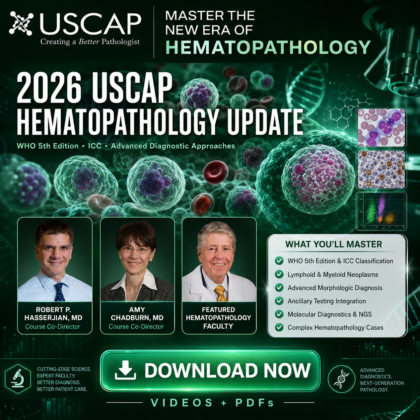




Advanced Diagnostic
Hematopathology
An advanced case-based course integrating morphology, immunophenotyping,
molecular testing and genomic technologies for challenging myeloid
and lymphoid disorders.
APRIL 9, 2026
VIDEOS
PDFs
How Do We Turn Complex Molecular Data
Into an Accurate Hematopathology Diagnosis?
Our understanding of the molecular pathogenesis of hematopoietic and lymphoid
tumors has advanced significantly. Next-generation technologies now allow
increasingly precise interrogation of tumor genomes and are moving personalized
medicine closer to routine clinical practice.
At the same time, the increasing volume and complexity of diagnostic information
requires pathologists to continuously reassess disease definitions,
classification criteria and testing strategies.
Modern hematopathology therefore depends on the
integration of morphology, immunophenotypic studies,
molecular findings and genetic data rather than interpretation
of any individual test in isolation.
From Specimen → to Integrated Diagnosis
Recognize the Pattern
Evaluate morphologic findings and establish the initial diagnostic framework.
Characterize the Proliferation
Select and interpret appropriate ancillary immunophenotypic studies.
Interrogate the Disease
Use molecular methodologies to investigate diagnostically relevant abnormalities.
Refine Classification
Incorporate emerging genomic technologies into difficult diagnostic workups.
Reach the Diagnosis
Combine morphologic and ancillary findings to establish an accurate,
clinically meaningful diagnosis.
Complex Disorders. Practical Diagnostic Approaches.
This long course addresses important knowledge gaps and challenging diagnostic
scenarios involving selected myeloid and lymphoid disorders.
Each lecture is paired with case-based diagnostic examples
designed to demonstrate practical and comprehensive approaches to difficult
hematopathology workups.
The curriculum spans common and unusual
myeloid, histiocytic, B-cell and T-cell proliferations,
with particular attention to appropriate immunophenotypic and genetic testing strategies.
Four Major Areas of Hematopathology
MYELOID NEOPLASMS
Review challenging myeloid disorders, including pediatric
myelodysplastic syndromes/neoplasms and their differential diagnosis.
B-CELL NEOPLASMS
Explore diagnostic approaches to high-grade and splenic B-cell lymphomas,
including classification challenges.
T-CELL LYMPHOMAS
Examine advances in peripheral T-cell lymphomas and their evolving
diagnostic landscape.
HISTIOCYTIC & DENDRITIC NEOPLASMS
Review new concepts and molecular insights relevant to these uncommon
and diagnostically challenging neoplasms.
Beyond Morphology
Emerging technologies are reshaping how hematopoietic and lymphoid
neoplasms are investigated and classified.
NEXT-GENERATION TECHNOLOGIES
Understand new genomic technologies relevant to contemporary diagnostic hematopathology.
ADVANCED MOLECULAR TESTING
Explore how advanced molecular studies can support more accurate and comprehensive diagnoses.
PRACTICAL TEST SELECTION
Consider cost-effective application of advanced testing across different practice settings.
INTEGRATED INTERPRETATION
Connect ancillary findings with morphologic and clinical information
to resolve difficult diagnostic scenarios.
What You’ll Learn
Apply Current Diagnostic Criteria
Review current diagnostic criteria for selected challenging B-cell,
T-cell, histiocytic/dendritic and myeloid neoplasms affecting adults and children.
Understand Emerging Molecular Technologies
Discover technologies enabling increasingly accurate and comprehensive
hematopathology diagnosis.
Use Testing More Practically
Learn cost-effective approaches to advanced molecular testing
across different diagnostic practice settings.
Solve Complex Diagnostic Scenarios
Develop integrated approaches to difficult cases using ancillary testing
and comprehensive interpretation.
Lectures & Diagnostic Topics
Novel Genomic Technologies in Hematopathology:
A Primer for the Diagnostic Pathologist
New Concepts in Histiocytic/Dendritic Neoplasms
Pediatric Myelodysplastic Syndromes/Neoplasms
and Their Differential Diagnosis
Approach to the Diagnosis of High-Grade B-Cell Lymphomas
Advances in Peripheral T-Cell Lymphomas
A Roadmap for the Classification of Splenic B-Cell Lymphomas
Q&A
Not Just Classification.
Diagnostic Problem Solving.
Each lecture is paired with diagnostic case examples designed to demonstrate
practical approaches to challenging hematopathology workups.
Who Is This Course For?
Designed for pathologists seeking advanced education in the diagnosis
and workup of hematopoietic and lymphoid neoplasms.
Modern Hematopathology Requires
More Than Morphology Alone
Disease definitions and diagnostic criteria continue to evolve as molecular
knowledge expands and increasingly sophisticated technologies become available.
The challenge is not simply obtaining more data—it is understanding
which tests to use, when to use them,
and how to integrate their results into a coherent diagnosis.
Included With This Course
▶ Video Lectures
Advanced educational lectures covering challenging hematopathology topics.
▤ Course PDFs
Supporting PDF educational materials included with the course.
Recognize the Pattern.
Interrogate the Biology.
Integrate the Diagnosis.
A case-based educational course exploring challenging myeloid,
histiocytic, B-cell and T-cell disorders through modern molecular
testing and integrated diagnostic interpretation.



Reviews
There are no reviews yet.