
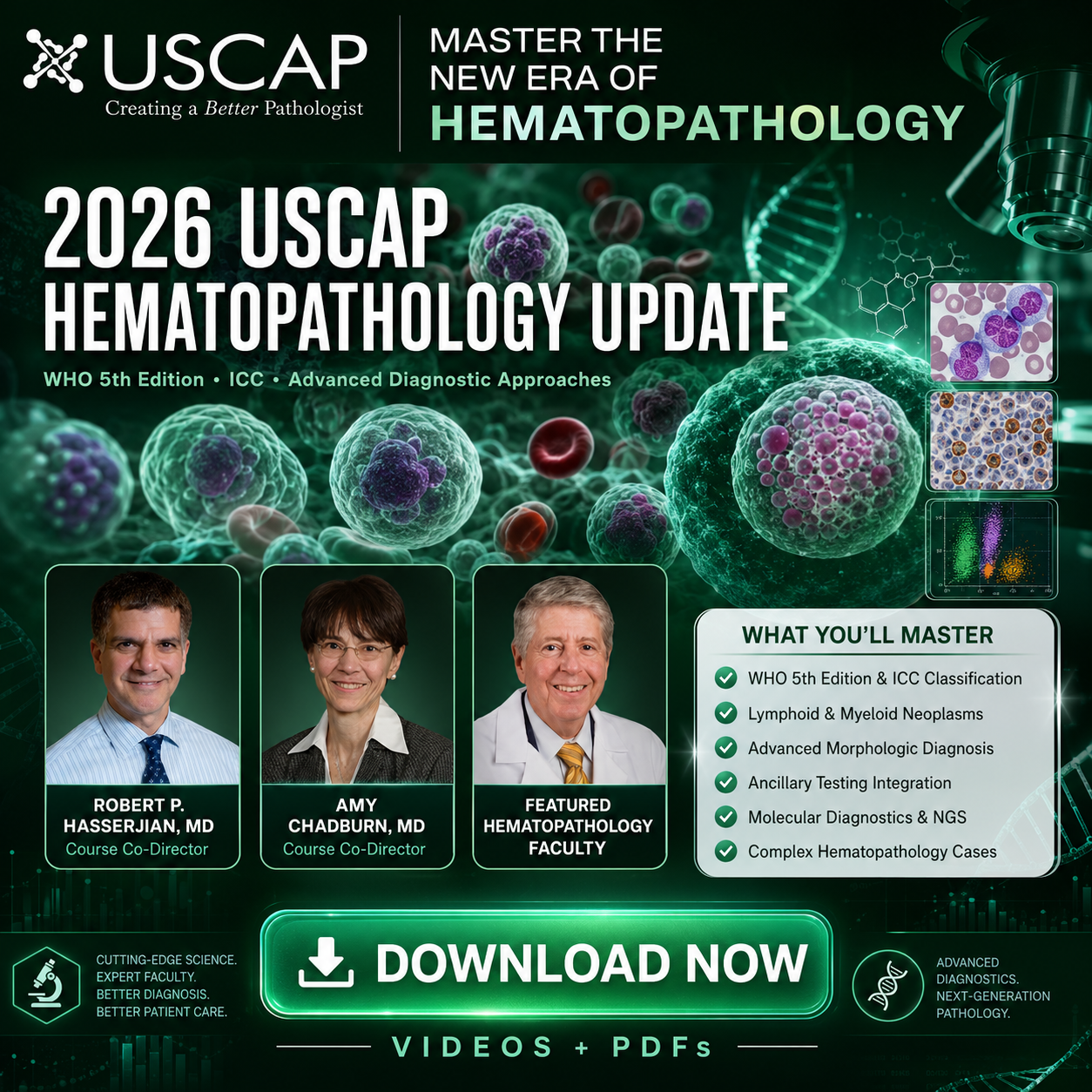









2026 USCAP Hematopathology Update
A comprehensive advanced review of modern hematopathology covering lymphoid and myeloid neoplasms, leukemia, lymphoma, bone marrow pathology, molecular diagnostics, WHO 5th Edition classification and the International Consensus Classification.
Before You Buy
Preview a sample of the educational content before purchasing.
Course Overview
The 2026 USCAP Hematopathology Update provides an advanced review of the morphologic diagnosis and modern classification of hematolymphoid disorders.
The program covers both lymphoid and myeloid pathology, with particular emphasis on applying the WHO Classification of Haematolymphoid Tumours, 5th Edition, and the International Consensus Classification (ICC) in everyday diagnostic practice.
With molecular testing and next-generation sequencing becoming increasingly important in hematopathology, accurate morphologic interpretation remains fundamental for selecting appropriate ancillary studies and integrating molecular, immunophenotypic, cytogenetic and clinical findings into a final diagnosis.
Course Highlights
Complete Course Content
Review reactive lymphadenopathies and important morphologic patterns that can mimic hematolymphoid neoplasia.
Amy Chadburn, MD
Diagnostic evaluation and classification of plasma cell disorders and plasma cell neoplasms.
Robert Lorsbach, MD, PhD
Coverage includes CLL, Mantle Cell Lymphoma, Hairy Cell Leukemia, Splenic Marginal Zone Lymphoma, Lymphoplasmacytic Lymphoma, Small Lymphocytic Lymphoma and Richter Transformation.
Laurence L. de Leval, MD, PhD
Morphologic and diagnostic approach to follicular lymphoma and nodal marginal zone lymphoma.
Ioannis Anagnostopoulos, MD
Diagnosis and classification of extranodal and splenic B-cell lymphoid neoplasms.
Judith A. Ferry, MD
Detailed discussion of Burkitt lymphoma, high-grade B-cell lymphomas and diffuse large B-cell lymphoma.
Amy Chadburn, MD
Important variants and challenging presentations of diffuse large B-cell lymphoma.
Judith A. Ferry, MD
Current diagnostic criteria and differential diagnosis of Hodgkin lymphoma and related entities.
Ioannis Anagnostopoulos, MD
Hematolymphoid proliferations associated with immunodeficiency and fluid-based lymphoma entities.
Amy Chadburn, MD
Diagnostic approach to peripheral T-cell lymphomas.
Laurence L. de Leval, MD, PhD
Continued discussion of classification, morphology and differential diagnosis of T-cell lymphoma.
Laurence L. de Leval, MD, PhD
Diagnosis of primary cutaneous lymphoid neoplasms.
Judith A. Ferry, MD
Morphologic evaluation of non-neoplastic and reactive bone marrow abnormalities.
Robert P. Hasserjian, MD
Current classification and diagnostic criteria for myeloproliferative neoplasms.
Daniel A. Arber, MD
Updated approach to myelodysplastic neoplasms and clonal cytopenic disorders.
Robert P. Hasserjian, MD
Pediatric myeloid malignancies and hereditary/germline predisposition disorders.
Robert Lorsbach, MD, PhD
Modern classification and diagnosis of AML incorporating morphology, immunophenotyping and molecular findings.
Joseph D. Khoury, MD
Diagnostic approach to B- and T-lineage lymphoblastic leukemia and lymphoma.
Robert Lorsbach, MD, PhD
Classification and differential diagnosis of histiocytic and dendritic-cell neoplasms.
Joseph D. Khoury, MD
Review of mixed phenotype acute leukemia and hematologic neoplasms associated with eosinophilia.
Joseph D. Khoury, MD
Current diagnostic criteria and classification of systemic mastocytosis.
Daniel A. Arber, MD
Morphologic and molecular evaluation of overlapping myelodysplastic and myeloproliferative neoplasms.
Daniel A. Arber, MD
Evaluation of disease progression, treatment effects and post-treatment bone marrow findings.
Robert P. Hasserjian, MD
Expert panel discussions addressing practical and challenging hematopathology cases.
Who Is This Course For?
✓ Practicing Pathologists
✓ Academic Pathologists
✓ Community Pathologists
✓ Hematopathologists
✓ Pathology Residents
✓ Pathology Fellows
✓ Hematopathology Fellows
✓ Hematologists interested in diagnostic pathology
✓ Physicians preparing for pathology board examinations or continuing certification
Learning Objectives
After completing the educational material, learners should have an improved understanding of how to:
✓ Recognize morphologic features of common and uncommon myeloid and lymphoid neoplasms.
✓ Differentiate neoplastic processes from reactive and non-neoplastic hematolymphoid proliferations.
✓ Apply WHO 5th Edition criteria to hematopoietic neoplasms.
✓ Apply International Consensus Classification (ICC) criteria.
✓ Approach cases where WHO and ICC classifications may produce different diagnoses.
✓ Select appropriate ancillary studies based on morphologic and clinical findings.
✓ Use ancillary testing efficiently and cost-effectively.
✓ Interpret molecular, immunophenotypic and other ancillary results.
✓ Integrate morphology, clinical findings and ancillary testing into a final diagnosis.
Why This Course Matters
Modern hematopathology increasingly incorporates advanced molecular technologies, including next-generation sequencing. However, morphology continues to serve as the foundation for accurate hematopathologic diagnosis.
Correct morphologic interpretation helps determine which ancillary investigations are necessary and allows pathologists to correctly interpret molecular, immunophenotypic and genetic findings.
This program combines classic morphology with contemporary molecular and classification-based hematopathology, making it particularly useful for pathologists seeking an updated review of current diagnostic practice.
Major Topics
Hematopathology
Hematolymphoid Pathology
Lymphoma
Leukemia
Bone Marrow Pathology
AML
Myelodysplastic Neoplasms
Myeloproliferative Neoplasms
Plasma Cell Neoplasms
DLBCL
Burkitt Lymphoma
Hodgkin Lymphoma
T-Cell Lymphoma
B-Cell Lymphoma
Lymphoblastic Leukemia
Systemic Mastocytosis
WHO 5th Edition
ICC Classification
Molecular Hematopathology
Access the 2026 USCAP Hematopathology Update
Videos + PDFs • Advanced Hematopathology Education
Videos + PDFs • Professional Medical Education
Reviews
There are no reviews yet.